
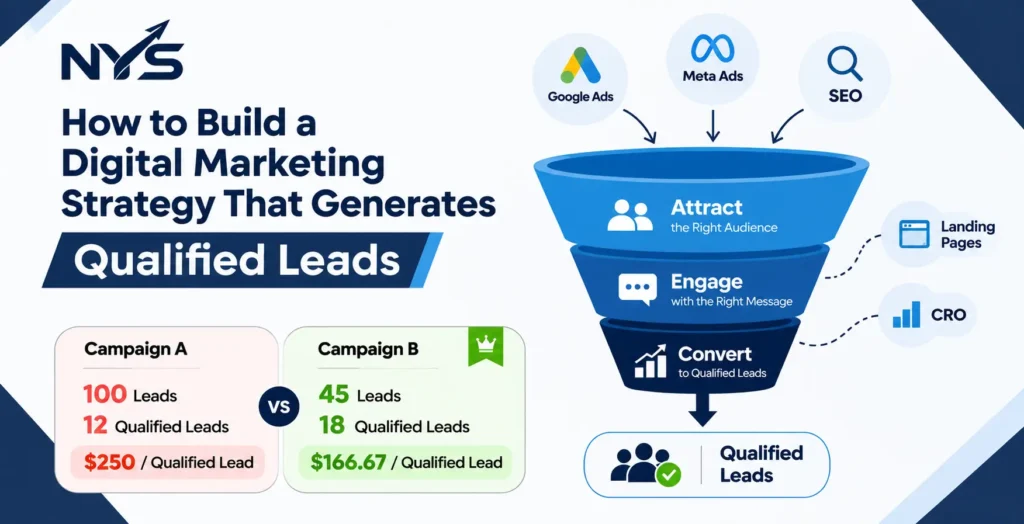
How to Build a Digital Marketing Strategy That Generates Qualified Leads
Imagine your marketing dashboard shows 100 new leads this month. Your advertising reports look encouraging, the cost per lead is low, and website traffic is increasing.
But when your sales team starts calling those leads, something doesn’t add up.
Most people are not interested in your actual service. Some are looking for something completely different, while others are simply comparing prices. After a few days, your team has spent considerable time following up, but only a handful of conversations have real business potential.
Now consider another campaign that generates just 45 enquiries. The number looks less impressive, but the people contacting your business understand your offering, match your target audience, and are more likely to become customers.
Which campaign would you rather invest in?
This is the question businesses should ask before increasing their marketing budgets.
The problem with many digital marketing efforts is not necessarily a lack of traffic, advertising, or content. It is the gap between attracting attention and generating genuine business opportunities.
A well-planned digital marketing strategy needs to close that gap. It should connect the right audience with the right offer, give potential customers a reason to enquire, and help the business understand which marketing activities are actually contributing to growth.
Let’s explore how to build that kind of strategy.
The Real Problem Isn’t Always a Lack of Leads
Businesses often measure marketing success by how many enquiries they generate. It is an understandable starting point, but it doesn’t tell the whole story.
Consider this hypothetical example of two advertising campaigns, each with a budget of $3,000.
| Performance metric | Campaign A | Campaign B |
|---|---|---|
| Advertising spend | $3,000 | $3,000 |
| Leads generated | 100 | 45 |
| Qualified leads | 12 | 18 |
| Cost per lead | $30 | $66.67 |
| Cost per qualified lead | $250 | $166.67 |
Campaign A generates more than twice as many leads. Yet Campaign B produces more qualified opportunities and has a lower cost per qualified lead.
The difference comes down to what happens after someone responds to an advertisement.
This is why businesses should stop treating every form submission as a marketing success.
A person who downloads a brochure, someone comparing several service providers, and a business owner actively looking to hire an agency are not necessarily at the same stage of the buying journey.
A strong marketing strategy recognises these differences.
The objective isn’t to generate the maximum number of enquiries. It is to generate enquiries that have a genuine chance of becoming business.
Before Choosing Marketing Channels, Understand the Business You’re Trying to Grow
One of the first mistakes businesses make is deciding where to advertise before understanding what they need from their marketing.
Should they invest in Google Ads? Should they run Meta campaigns? Is SEO worth prioritising? Would a landing page help?
These are important questions, but they shouldn’t come first.
Start with the commercial objective.
For a B2B company, the goal might be to secure more consultation requests from businesses in a particular industry. An ecommerce brand may want to improve purchase conversion rates. A professional service provider may want fewer enquiries but a higher proportion of customers who meet its requirements.
Each objective changes the marketing approach.
Before developing campaigns, work out three things:
Who is a valuable customer? Identify the type of customer or business that is most likely to benefit from your services. Consider industry, location, company size, requirements, and purchasing capacity.
What makes someone ready to enquire? Understand the problem that brings them to your business. Are they actively looking for a solution, comparing providers, or researching their options?
What makes an enquiry worth pursuing? Define the requirements a lead should meet before it becomes a sales opportunity.
For example, a digital services company might consider an enquiry qualified when the prospect has a relevant business, a suitable project requirement, a realistic budget, and the intention to move forward within a reasonable timeframe.
These criteria will differ between businesses. What matters is that marketing and sales agree on what a good lead looks like.
Without that agreement, marketing may continue delivering contacts that sales teams do not consider useful.
Build Your Digital Marketing Strategy Around the Customer’s Buying Journey
Potential customers rarely move from discovering a business to making a purchase in one step.
Someone might first search for information, visit a few websites, compare different providers, read reviews, and return several days later to submit an enquiry.
Your marketing needs to account for that behaviour.
Instead of treating SEO, paid advertising, and social media as separate activities, think about the role each channel plays in helping a customer make a decision.
When Customers Are Searching for a Solution
This is where search engine optimisation and Google Ads can play an important role.
When someone searches for a specific service, there is usually a reason behind that search. They may be researching a problem, exploring possible solutions, or looking for a provider.
Your content and advertisements should reflect that intent.
For example, a person searching for general information about digital advertising probably needs a different page from someone searching for a performance marketing agency.
Sending both visitors to the same generic homepage may not give either of them the experience they need.
A better approach is to connect each search theme with a relevant page that addresses the visitor’s actual requirement.
When Customers Need to Understand Their Options
Not everyone starts by searching for a service provider.
Some people discover a business through social media, an industry discussion, a video, or a useful article.
At this stage, the objective is to give them a reason to learn more.
Meta Ads, educational content, and relevant remarketing campaigns can help businesses stay visible while potential customers explore their options.
The message should be helpful and specific. Simply repeating promotional claims does very little to build confidence.
When Customers Are Ready to Make a Decision
Once a prospect has shortlisted a few providers, the questions become more practical.
Can this company handle my requirements? Does it understand my industry? What does its service actually include? How do I get started?
Your service pages, project information, relevant case studies, and enquiry process should answer these questions.
This is where a business can lose an otherwise valuable lead. The customer may already be interested, but the website does not provide enough clarity to encourage the next step.
A good digital marketing strategy accounts for all three stages rather than focusing only on the first click.
Performance Marketing: Where Strategy Meets Measurable Business Results
Performance marketing should not be viewed simply as another way to run paid advertisements.
Its real value lies in connecting marketing investment with measurable actions and using the resulting information to make better decisions.
Think of it this way: launching an advertising campaign is only the beginning. The more important questions are what happens after the campaign goes live, who responds, whether those people are relevant, and how many progress towards becoming customers.
That is the thinking behind a performance-focused approach.
Google Ads: Reach People With Active Search Intent
Google Ads can help a business reach potential customers who are already searching for relevant services.
However, a large keyword list does not automatically make a good campaign.
A company targeting business owners, for example, needs to distinguish between people researching marketing concepts and those actively looking to hire a service provider.
The difference in search intent can have a considerable impact on lead quality.
Campaign structure, keyword selection, negative keywords, advertisement messaging, and landing-page relevance all need to work together.
Explore Google Ads and PPC services.
Meta Ads: Create Interest Before the Customer Starts Searching
Facebook and Instagram advertising offer a different opportunity.
Rather than waiting for potential customers to search for a service, businesses can introduce their products, services, and offers to relevant audiences.
This can be particularly useful when the customer needs to understand a problem or see the value of a solution before making an enquiry.
But creative quality matters. A visually attractive advertisement may generate attention without attracting the right people.
The offer, message, audience, and destination page must all be aligned.
Explore Meta Ads services.
Retargeting: Give Interested Visitors a Reason to Return
Not everyone is ready to contact a business immediately.
A visitor may review your service page, compare your offering with competitors, and leave without taking action.
Rather than assuming that this person is no longer interested, businesses can use eligible remarketing audiences to share relevant information and reconnect with previous visitors.
The important part is relevance. Different visitors may need different messages depending on what they previously explored.
The Bigger Picture
Google Ads, Meta Ads, and remarketing are not separate growth strategies. They are different tools that can support the same acquisition objective.
Their success should be evaluated using more than impressions and clicks.
A campaign that attracts the right prospects, delivers relevant traffic, and generates qualified opportunities is generally more useful than one that simply produces impressive engagement numbers.
Your Advertising May Be Working. Your Landing Page May Be the Problem.
Here is a situation worth considering.
A company runs a search advertising campaign for one of its professional services. The advertisements are relevant, people click, and traffic reaches the website.
But enquiries remain low.
The natural reaction might be to increase the advertising budget, change keywords, or launch another campaign.
Before doing that, examine the landing page.
Does the headline match the advertisement? Can a visitor understand the service without searching through multiple pages? Is the value of the offer clear? Is the enquiry process simple?
A landing page should not make visitors work hard to understand what a business is offering.
For example, if an advertisement promotes a specific B2B service, the landing page should explain that service directly rather than sending visitors to a homepage containing ten unrelated offerings.
The enquiry form deserves the same attention.
Asking for too much information too early can discourage genuine prospects. Asking for too little may make it difficult to understand whether an enquiry is relevant.
The balance depends on the service, sales process, and qualification requirements.
This is also where Conversion Rate Optimisation (CRO) becomes valuable.
Rather than assuming that more advertising will solve the problem, CRO examines where visitors lose interest or encounter difficulties.
It gives businesses an opportunity to improve the performance of the traffic they are already attracting.
Explore landing page design and conversion rate optimisation.
The Marketing Numbers You Should Actually Be Discussing With Your Sales Team
Many businesses receive regular marketing reports. The challenge is that the reports and the sales team’s experience do not always tell the same story.
The marketing dashboard might show a growing number of leads, while the sales team reports that most enquiries are irrelevant.
This disconnect is worth investigating.
Instead of limiting reporting to advertising metrics, connect the marketing data with the sales process.
Here are some useful measurements:
| Metric | What it tells you |
|---|---|
| Cost per lead (CPL) | How much it costs to generate an enquiry |
| Lead qualification rate | What proportion of enquiries meet your criteria |
| Cost per qualified lead | How much it costs to generate a relevant opportunity |
| Lead-to-customer rate | What proportion of leads eventually become customers |
| Customer acquisition cost (CAC) | The cost of acquiring a new customer |
| Return on ad spend (ROAS) | Attributed advertising revenue compared with advertising spend |
For example, suppose a marketing campaign generates 60 enquiries, but only nine meet the business’s qualification criteria.
That information should influence the next campaign decision.
The question is not just why 51 enquiries were unsuccessful. It is whether the campaign attracted the wrong audience, whether the advertisement communicated the offer poorly, or whether the qualification process needs improvement.
This is the point where data becomes useful.
Google Ads conversion measurement, Google Analytics, and a properly maintained CRM can help businesses understand different stages of the acquisition journey.
Useful resources:
Expanding Into Australia, the UK, USA or Gulf Countries? Don’t Use the Same Campaign Everywhere.
International expansion can create excellent opportunities, but it also introduces a challenge that businesses sometimes underestimate: different markets do not necessarily respond to the same offer or message.
A company planning to target Australia, the UK, the USA, and the Gulf region should not simply duplicate one campaign and change its geographical targeting.
Consider the practical questions first.
Does the business understand the local competition? Are people searching for its services using the same terminology? Does the website clearly explain service availability? Can the sales team respond during the local working day?
For Gulf markets, the approach may also need to account for language preferences and the differences between individual countries.
A business targeting UAE customers may have different audience requirements from one targeting Saudi Arabia or Qatar.
A sensible international rollout starts with a defined customer segment and a specific market.
Rather than launching everywhere at once, test whether the business can attract relevant enquiries from one priority audience. Study the quality of those enquiries, the objections prospects raise, and the sales conversations that follow.
That information can help shape the next market launch.
The objective is not to have advertisements running in as many countries as possible. It is to establish whether the business has a workable customer acquisition process in each market.
A 90-Day Plan: From Marketing Activity to a Working Acquisition System
A business does not need to launch every channel at once. In fact, trying to do everything simultaneously can make it difficult to understand what is working.
A phased rollout is often a more practical approach.
Days 1–30: Find the gaps before spending more
Review the current website, existing campaigns, customer enquiries, lead quality, and conversion tracking.
Speak to the sales team. Find out which enquiries are worth pursuing and which ones regularly waste time.
The outcome should be a clear understanding of the target customer, the offer, the acquisition goal, and the existing problems.
Days 31–60: Launch focused campaigns
Select the channels that fit the customer journey.
Build relevant advertisements, improve the destination pages, and make sure important conversions are being recorded.
Avoid launching multiple unrelated campaigns without a clear reason. Start with a manageable set of tests that can produce useful information.
Days 61–90: Use the evidence to make decisions
Compare the quality of incoming enquiries, not just the number of submissions.
Identify which audience segments are responding, which messages are attracting relevant prospects, and where visitors are dropping out of the journey.
Use the findings to decide whether to increase investment, improve the offer, change targeting, or work on the website experience.
These stages are an illustrative framework rather than a guaranteed timeline. The right pace depends on the business’s budget, market, sales cycle, and available data.
Why Businesses Need a Connected Digital Marketing Partner
A digital marketing campaign does not exist in isolation.
An advertisement can attract a potential customer, but the website has to explain the offer. The landing page has to encourage action. Tracking needs to record meaningful results, and the sales team has to follow up appropriately.
When these activities are managed separately, important information can get lost between teams.
For example, the advertising team may be optimising campaigns for low-cost enquiries while the sales team is trying to reach customers with entirely different requirements.
A more connected approach brings these activities into the same conversation.
This is the thinking behind NYS Softech’s digital growth offering.
NYS Softech works across digital marketing and development, allowing businesses to address different parts of their online customer journey.
Its areas of work include performance marketing, paid advertising, website development, landing page design, and conversion-focused optimisation.
The objective is to consider how these activities support one another, instead of treating each service as a completely separate task.
For a business trying to improve lead generation, that means looking beyond the advertisement and considering what happens before, during, and after someone visits the website.
Learn more about NYS Softech and its digital solutions.
Frequently Asked Questions
What makes a digital marketing strategy successful?
A successful strategy connects marketing activity with commercial objectives. It attracts the right audience, communicates a clear offer, generates relevant enquiries, and gives the business enough information to understand which activities contribute to sales opportunities.
How can a business generate qualified leads instead of just more leads?
Start by defining what a qualified lead means for your business. Then align audience targeting, advertising messages, landing-page content, and enquiry forms with those requirements. Review the actual enquiries with your sales team and use that feedback to refine campaigns.
Is performance marketing better than traditional digital marketing?
They serve different purposes. Digital marketing is the broader discipline covering online channels and customer engagement. Performance marketing focuses on measuring marketing activity against defined actions and outcomes. It can be an important part of a wider digital marketing strategy.
Should businesses invest in Google Ads or Meta Ads first?
That depends on how customers discover and evaluate the service. Google Ads may be suitable when potential customers actively search for the offering. Meta Ads may be more appropriate when the business needs to introduce its services or build interest among relevant audiences. The decision should be based on customer behaviour and campaign objectives.
Why are my advertising campaigns generating enquiries but not sales?
There may be a mismatch between your targeting, offer, lead qualification criteria, or sales follow-up. It is also possible that the enquiries are genuine but need more information or time before making a decision. Review the journey from advertisement to final sales outcome before changing the advertising budget.
How should a business approach international lead generation?
Start with a specific market and customer segment. Research local competition, customer expectations, search behaviour, and service requirements. Adapt campaign messaging and landing pages to the market, and make sure your team can handle incoming enquiries appropriately.
Final Thoughts: Stop Measuring Marketing Only by the Number of Leads
A growing lead count can look encouraging, but it does not necessarily mean your business is getting closer to its goals.
What matters is whether your marketing is attracting people who need what you offer, understand its value, and have a genuine reason to start a conversation with your business.
That requires more than running advertisements or publishing content. It requires a connected approach to audience targeting, performance marketing, website experience, conversion optimisation, and sales feedback.
A strong digital marketing strategy helps businesses understand where their opportunities are coming from, where potential customers are being lost, and what needs to change next.
The goal isn’t to generate more enquiries just to make the marketing report look better. It’s to create more meaningful opportunities for your business.
Looking to make your marketing investment work harder? Connect with NYS Softech to discuss a digital marketing approach built around your business goals, target audience, and lead generation requirements.